Every morning, millions of hands across South India create intricate patterns at their doorsteps—a ritual that has continued unbroken for over 5,000 years. This is Kolam, and it's so much more than just art.
Kolam is a living meditation, a mathematical marvel, a spiritual practice, and a cultural treasure all woven into one beautiful tradition. In our fast-paced modern world, this ancient art form offers something profoundly relevant: a daily practice that calms the mind, sharpens focus, connects us to heritage, and brings beauty into everyday life.
🏛️ A Living Cultural Heritage
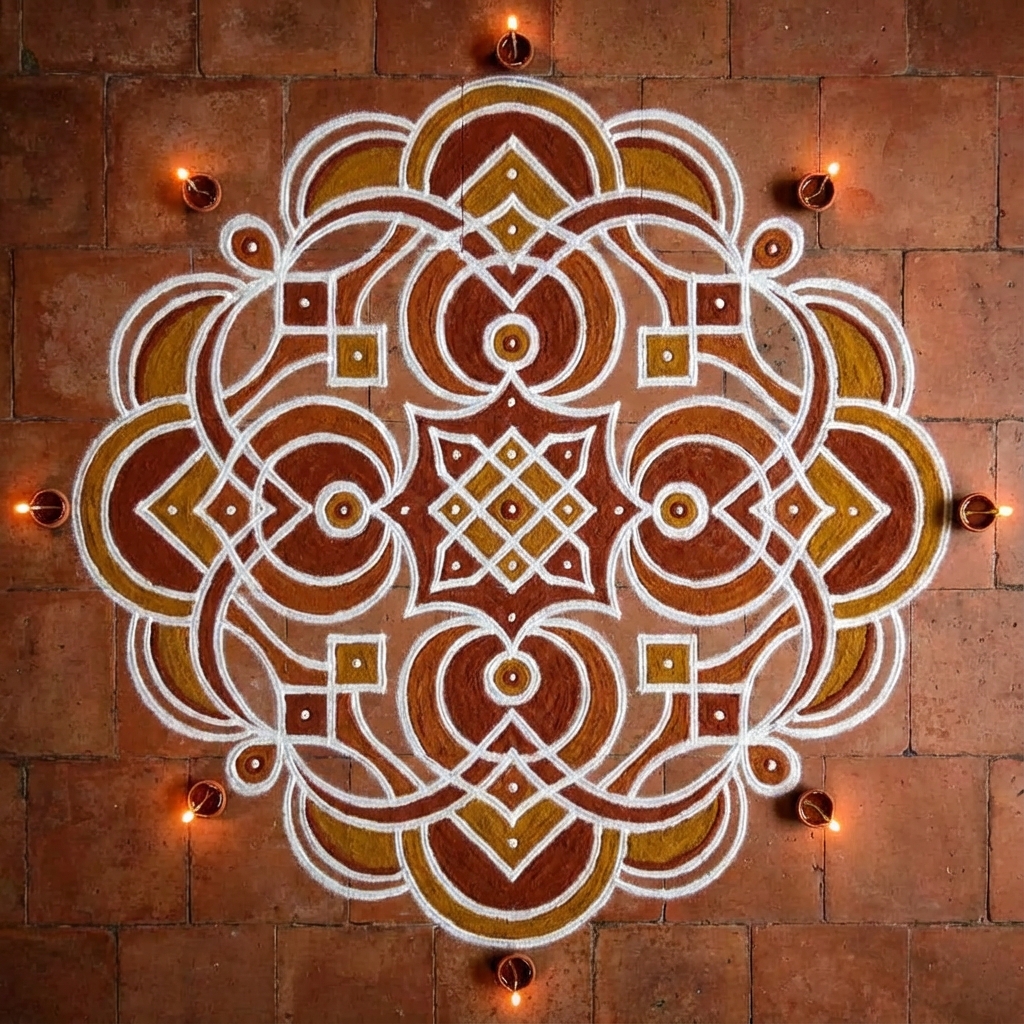
A traditional Kolam pattern showcasing the intricate geometric beauty of this ancient art form
Origins in Ancient India
Kolam traces its roots back over 5,000 years to the Indus Valley Civilization. Archaeological evidence suggests that similar geometric patterns adorned the floors of ancient homes, making Kolam one of the world's oldest continuously practiced art forms.
The Daily Ritual
Traditionally created by women at dawn, Kolam transforms the threshold of a home into a sacred space. Using rice flour, the patterns serve a dual purpose: beautifying the entrance while providing food for ants, birds, and small creatures—embodying the principle of living in harmony with all beings.
Symbolism & Meaning
Welcoming Prosperity: The threshold Kolam invites Lakshmi, the goddess of wealth and prosperity, into the home.
Protection: The continuous, unbroken lines are believed to ward off negative energy.
Community Connection: Kolam patterns are passed down through generations, creating an unbroken chain of cultural transmission from grandmother to mother to daughter.
Impermanence: Created fresh each day and washed away by footsteps and weather, Kolam teaches the beauty of impermanence and non-attachment.
Regional Variations
Known by different names across India—Rangoli in North India, Muggu in Andhra Pradesh, Alpana in Bengal—each region has developed its own distinctive styles while maintaining the core principles of this sacred art.
🕉️ Spiritual Significance & Mindfulness
In an age of constant distraction, Kolam offers a profound path to mindfulness and spiritual connection.
Moving Meditation
Creating a Kolam is a form of active meditation. As your hand flows from dot to dot, creating continuous lines, your mind enters a state of focused calm. The repetitive, rhythmic motions quiet mental chatter and bring you fully into the present moment.
Sacred Geometry
Kolam patterns embody sacred geometry—the belief that certain geometric proportions and patterns reflect the fundamental structure of the universe. Many Kolam designs incorporate:
- Mandalas: Circular patterns representing wholeness and cosmic unity
- Yantras: Geometric diagrams used in meditation and spiritual practice
- Symmetry: Reflecting the balance and harmony inherent in nature
- Infinite Loops: Symbolizing the eternal cycle of life, death, and rebirth
The Morning Ritual
Starting the day by creating a Kolam sets a powerful intention. This quiet, creative act before the rush of daily life becomes a anchor point—a moment of peace, beauty, and connection to something larger than ourselves.
Letting Go
Perhaps Kolam's most profound spiritual teaching is about impermanence. You spend time creating something beautiful, knowing it will be gone by evening. This practice cultivates non-attachment and helps us appreciate the present moment without clinging to outcomes.
🧠 Scientific Benefits: What Research Shows
Modern science is now validating what practitioners have known for millennia—creating Kolam offers remarkable benefits for mental and physical health.
🧘 Stress Reduction
The meditative nature of Kolam creation activates the parasympathetic nervous system, reducing cortisol levels and promoting deep relaxation.
🎯 Enhanced Focus
Creating intricate patterns requires sustained attention, strengthening neural pathways associated with concentration and mindfulness.
🖐️ Fine Motor Skills
The precise hand movements involved in Kolam creation improve hand-eye coordination and fine motor control, beneficial for all ages.
🧩 Cognitive Enhancement
Planning and executing complex patterns exercises spatial reasoning, pattern recognition, and problem-solving abilities.
💆 Mental Health
Regular practice has been linked to reduced anxiety, improved mood, and greater emotional regulation—similar to other mindfulness practices.
🧓 Cognitive Aging
Engaging in complex creative activities like Kolam may help maintain cognitive function and reduce risk of age-related decline.
Mindfulness in Action
Research on mindfulness-based practices shows that activities requiring focused attention on the present moment—exactly what Kolam demands—can:
- Reduce symptoms of depression and anxiety
- Improve emotional regulation
- Enhance overall well-being and life satisfaction
- Strengthen immune system function
- Improve sleep quality
📐 Mathematical & Geometric Marvel
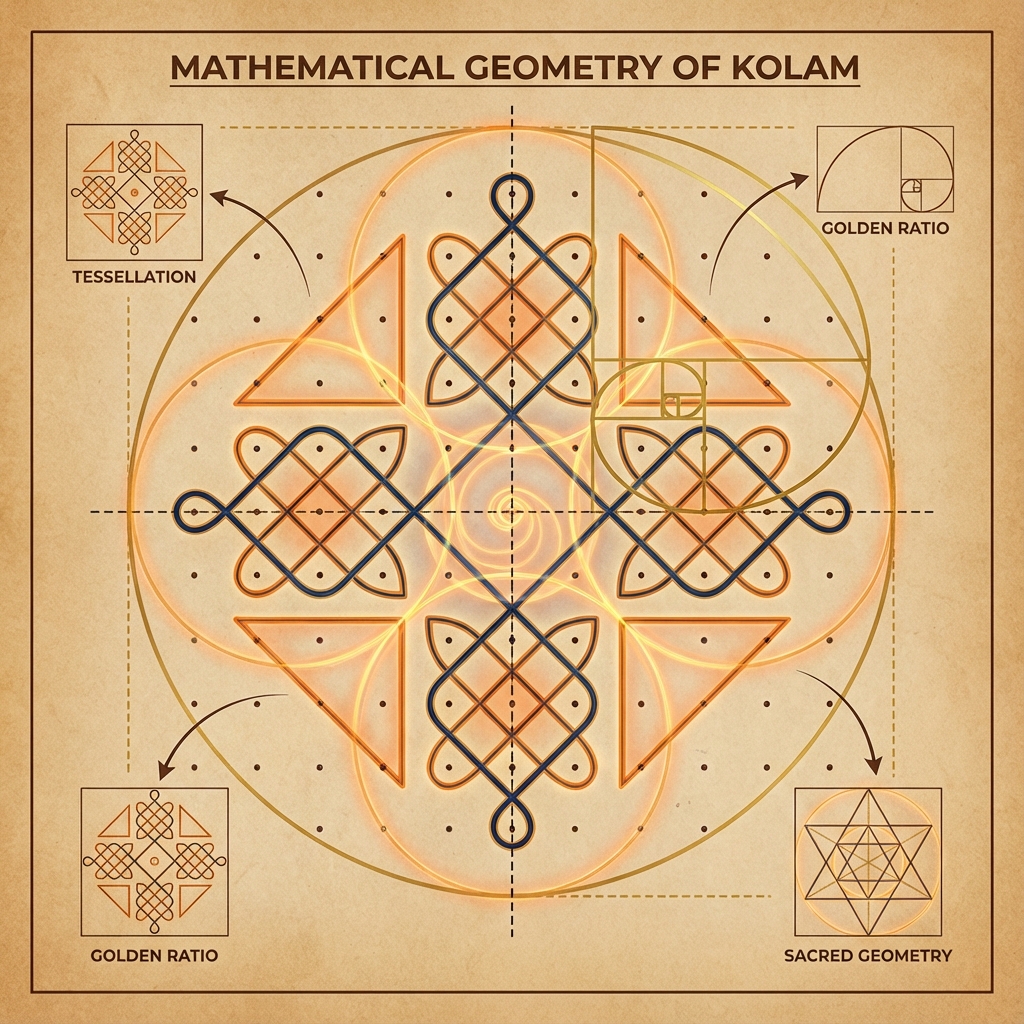
The mathematical beauty of Kolam: symmetry, tessellation, and sacred geometry
Kolam is a masterclass in applied mathematics, making it an invaluable educational tool for understanding complex mathematical concepts through hands-on practice.
Symmetry & Transformation
Kolam patterns demonstrate multiple types of symmetry:
- Rotational Symmetry: Patterns that look the same when rotated around a central point
- Reflection Symmetry: Mirror images across one or more axes
- Translational Symmetry: Repeating patterns that tile infinitely
Tessellation & Tiling
Many Kolam designs are perfect examples of tessellation—patterns that cover a plane without gaps or overlaps. This concept is fundamental to:
- Architecture and design
- Computer graphics and animation
- Crystallography and materials science
- Art and visual design
Fibonacci & Golden Ratio
Some traditional Kolam patterns naturally incorporate the Fibonacci sequence and golden ratio—mathematical principles found throughout nature, from spiral galaxies to seashells to flower petals.
Fractals & Recursion
Advanced Kolam designs exhibit fractal properties—self-similar patterns that repeat at different scales. This same principle governs coastlines, snowflakes, and the branching of trees and blood vessels.
STEM Education
Kolam serves as an engaging entry point for teaching:
- Mathematics: Geometry, symmetry, patterns, sequences
- Computer Science: Algorithms, recursion, computational thinking
- Art: Design principles, spatial reasoning, visual composition
- Cultural Studies: Heritage, tradition, and cultural mathematics
🏠 Why Practice Kolam at Home?
1. Daily Mindfulness Ritual
In our screen-saturated lives, Kolam offers a screen-free, hands-on practice that grounds you in the present moment. Just 10-15 minutes each morning can transform your entire day.
2. Creative Expression
Kolam provides a creative outlet that doesn't require expensive materials or special training. Start simple and watch your skills—and confidence—grow organically.
3. Cultural Connection
For those of South Indian heritage living abroad, Kolam is a powerful way to maintain connection to your roots and pass cultural knowledge to the next generation. For others, it's an opportunity to appreciate and learn from a rich cultural tradition.
4. Family Bonding
Creating Kolam can become a cherished family activity. Children love the patterns, and it's a wonderful way to spend quality time together while developing fine motor skills and spatial reasoning.
5. Beautify Your Space
Transform your entrance, patio, or garden with beautiful, temporary art. Unlike permanent decorations, Kolam allows you to change your space daily, keeping it fresh and dynamic.
6. Eco-Friendly Art
Traditional Kolam uses natural, biodegradable materials—rice flour, colored powders made from natural sources. It's art that nourishes rather than pollutes, feeding small creatures while beautifying your space.
Perfect for Modern Life
Kolam adapts beautifully to contemporary living. You can:
- Create small designs on paper or in a dedicated tray
- Use chalk on patios or driveways
- Practice digitally to learn patterns
- Scale designs to fit any space
- Adapt traditional patterns with your own creative variations
Learn Kolam with AI Technology
While traditional learning takes years of dedicated practice and mentorship, modern AI technology can accelerate your journey dramatically. Kolam Master combines the authenticity of traditional patterns with cutting-edge artificial intelligence to provide:
- Real-time feedback on every stroke you make
- Personalized guidance tailored to your skill level
- Instant validation comparing your work to reference patterns
- Progress tracking showing your improvement over time
- Adaptive learning that adjusts difficulty as you improve
Learn in weeks what traditionally takes yearswithout sacrificing authenticity or cultural significance.
Begin Your Kolam Journey Today
Whether you're seeking mindfulness, creative expression, cultural connection, or simply a beautiful daily practice, Kolam welcomes you.
With Kolam Master's AI-powered guidance, you'll learn this ancient art form at your own pace, receiving real-time feedback and personalized tips as you progress from simple patterns to intricate masterpieces.
🌼 Start Learning KolamLearn more about AI-powered features →
Join thousands discovering the joy, peace, and beauty of this 5,000-year-old tradition.